
The research that inspired LearnScope
-
Emerging evidence finds high-quality district leadership meaningfully impacts student outcomes. Stemper (2022) and Lavy et al. (2023) find that moving from an average to a high-quality district leader influences student outcomes more than a 25% increase in instructional time or $1 million in additional funding, making leadership quality one of the highest-leverage variables a district can address.
Effective district leaders share a recognizable set of practices: focused system-wide priorities, clearly defined planning and decision-making routines, targeted investment in educator and school leader performance, and elevated expectations for adults and students. These patterns emerge consistently across research from Stemper and Lavy et al.
K–12 research alone does not yet provide an actionable playbook for district leaders. To close that gap, LearnScope draws on interdisciplinary research on managing complex organizations, including Zeynep Ton's Good Jobs Strategy, Jennifer Pahlka's work on state capacity, and Alan Daly's research on organizational networks in education.
LearnScope's School System Capacity Model translates this evidence into a practical framework for diagnosing and building district capacity, organized around three pillars, Clarity, Coherence, and Collective Learning.
At LearnScope, we take evidence seriously. Unfortunately, rigorous research on how to design and operate K–12 school systems is sparse, and only a handful of studies meet a baseline standard for empirical research. The gap is especially acute for district-level leadership, where clear evidence of impact connected to student outcomes is the hardest to find. Most research on district leadership has historically been qualitative or offered, at best, correlations between leadership practice and student outcomes.
Although we hope to help change this over time, we also feel a sense of urgency to provide better tools for K–12 leaders now. So, where do we start?
Existing Evidence Base
Our Review
We conducted a thorough literature review to identify the most compelling evidence on district leadership, which now serves as the foundation for LearnScope's work.
Most rigorous research within the US K-12 sector has focused on how interventions at the school- and classroom-level influence student outcomes. How effective is this curriculum? Does this tutoring program help students get back on track? Does this technology tool help struggling students? These narrower, intervention-focused questions offer a clearer path to isolating the impact of a specific program, even if they omit key information about the organizational context in which the programs operate.
The body of research focused on how district leadership influences student outcomes is thinner, both in volume and quality. A commonly cited 2014 Brown Center on Education Policy report described this gap:
“Research emerging over the past decade has provided strong evidence of the substantial effects that teachers have on their students’ achievement. More recent findings suggest that principals also have meaningful, albeit smaller, effects on student achievement. However, there is almost no quantitative research that addresses the impact of superintendents on student achievement [as of 2014].”
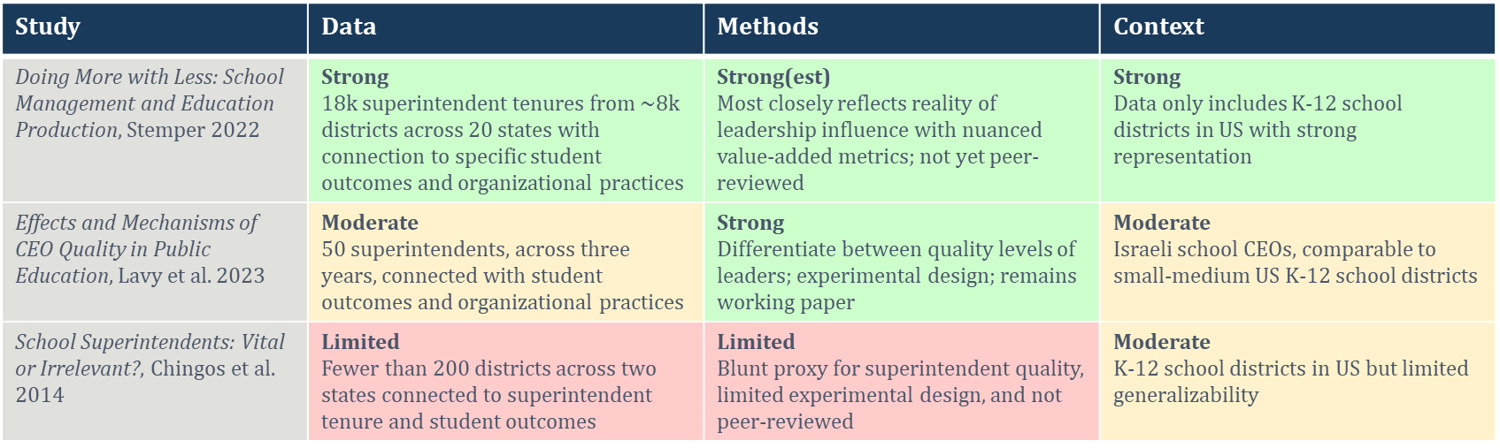
Beginning with the Brown Center report, the subsequent decade has offered a few important additions to the research. Our literature review surfaced two prominent studies related to the impact of superintendents or school district leadership on student outcomes.
Our Takeaway
Stemper and Lavy et al. converge on a clear finding: district leadership matters for students. Chingos et al., when read carefully, is consistent with that conclusion as well.
Stemper’s research finds that the effect size of a district leader on any individual student is smaller than the impact a teacher or school leader can have, but the impact is spread across many, many more students.
Lavy et al. reinforce these findings in an Israeli context, using experimental design to connect CEO quality to both student outcomes and specific organizational practices. Although the sample is only 50 district leaders outside of the US, the rigorous methods make this study worth using to help triangulate the effect size and specific ways district leaders influence overall performance.
The Brown Center report by Chingos et al. is often cited to suggest that superintendents do not matter for student outcomes, as its analysis narrows in on the superintendent as an individual. However, when the analysis is reframed to combine the impact of both the superintendent and the district infrastructure, the effect size is much more comparable to the findings of the other two studies here. At LearnScope, we believe this is a more appropriate interpretation, as the role of the superintendent is, in part, to build effective district-level support.
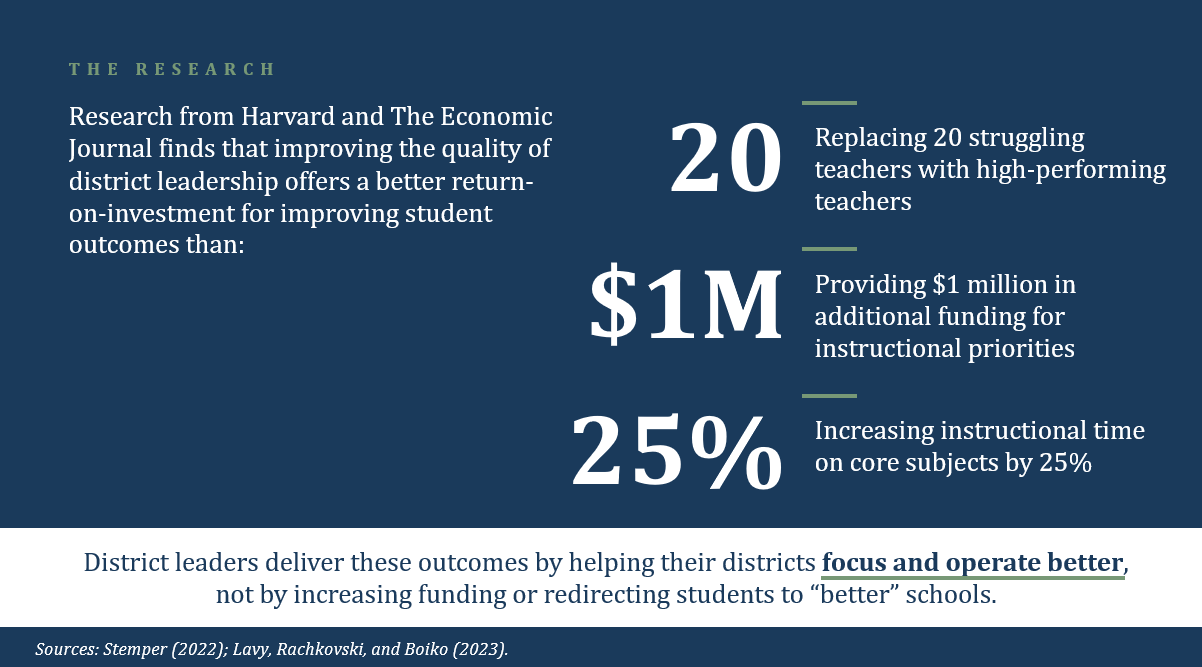
Importantly, both Stemper and Lavy et al. incorporate data on organizational practice to shed light on what leading practices might look like. Specifically, they find that high-quality leaders deliver outsized outcomes by operating better, not spending more. A few leading practices can be derived from their research:
Focused system-wide priorities — fewer initiatives, pursued more intensely
Clearly defined ways of working — the communication, collaboration, and decision-making routines that promote alignment and efficiency
Targeted talent management efforts — investing in elevating the performance of educators and school leaders
Elevated expectations — building a culture of success for both adults and students across the system
The emerging evidence from Stemper and Lavy tells us that district leadership matters, but it does not offer a fully actionable playbook for what high-quality district leadership actually looks like. The list above is directionally helpful but still leaves a meaningful gap between research and putting it into practice.
If K-12 research cannot (yet) give us an actionable playbook for district leaders, can we identify relevant, research-backed insights on managing complex organizations in other sectors? The answer, we think, is yes. We have built each of LearnScope’s offerings specifically to close this gap.
Interdisciplinary Evidence: Strategies for Managing Complex Organizations
The bodies of research below cut across disciplines but share common themes: managing complex organizations requires thoughtful design, strategic simplification, and structured collaboration.
Zeynep Ton
The Good Jobs Strategy & Good Jobs Institute
Professor Zeynep Ton's research at MIT studies why some organizations in low-margin industries consistently outperform their competitors. Her answer is counterintuitive.
Ton finds they invest more in their people, not less, but the investment only pays off because it's paired with reinforcing operational choices. These successful organizations focus on simplifying what they offer, standardizing routine work while empowering frontline judgment, cross-training staff, and operating with slack to promote higher-quality decision-making and performance. The companies that get this right don't just have happier employees, they have lower costs, lower turnover, and better performance. Ton’s work originally focused on retail, with exemplars like Costco and Trader Joe’s, but it has expanded across industries in recent years.
The Good Jobs Strategy has significant resonance for K-12 education. Districts that experience Initiative Debt and fragmented professional learning efforts create the same vicious cycle Ton describes in retail; overwhelmed staff, poor execution, declining results, and pressure to find a new program to solve their problems.
Her work suggests the path out isn't doing more, it is simplifying the work so that investment in people compounds and supports a clear, actionable strategy.
Jennifer Pahlka & Niskanen Center Team
Recoding America & The State Capacity Crisis
Jennifer Pahlka spent a career focused on helping government operate better, including as founder of Code for America and Deputy Chief Technology Officer under President Obama. Her book Recoding America is a deeply practical diagnosis of why well-intentioned policies falter at the point of implementation and fail to deliver the outcomes that matter.
The core problem isn't bad people or bad intentions. It's an institutional culture that treats policy design as the hard work and implementation as a downstream detail, layering on compliance requirements and oversight procedures until the system can barely deliver the service it was designed to provide. Pahlka calls this a crisis of state capacity: the gap between what government promises via policy and what it can execute.
K-12 school systems are experiencing a similar capacity crisis. Districts invest heavily in selecting the “perfect program” but often struggle with implementation, so students and educators never experience the full benefits. Pahlka's insight is that the highly impactful public sector organizations are the ones that invest in infrastructure to support implementation quality and two-way feedback mechanisms between frontline staff and executives to improve over time.
Alan Daly
Social Network Theory and Educational Change*
Alan Daly is a professor at UC San Diego who has spent his career researching the informal, relational structures that represent how work gets done in school systems and other educational settings. His work builds upon an interdisciplinary evidence base of how organizational networks function. Daly's findings consistently show that the informal structure of networks within school systems, including who exchanges information, where trust resides, and how subgroups form, shapes whether improvement efforts gain traction or stall.
Schools and districts run on a relational infrastructure that takes shape over decades as programs, policies, and leaders come and go. This infrastructure provides the paths for information, resources, and support to travel, yet it is often hidden in plain sight. Leveraging the methods of social network analysis, including those used by Daly, allows leaders to see – and influence – the hidden, relational infrastructure guiding how their district operates.
Taken together, these bodies of work point in the same direction as Stemper and Lavy et al. Across sectors, the organizations that outperform share a pattern: they simplify what they do, they treat implementation as seriously as strategy, and they measure success by outcomes delivered rather than activity generated. These are the mindsets and tools K-12 leaders need as we transition from an era of innovation and experimentation to one focused on execution and capacity.
Looking Ahead
The School System Capacity Model is in many ways a living document, and we expect to share updates at least annually. Each iteration will reflect our best understanding of the current research from across sectors, and we are committed to continually reviewing new evidence to evolve our services as stronger findings emerge. If better research exists, we want to find it. And if it doesn't exist yet, we want to help build it. If you have ideas about research to include, we would love to hear from you.
Even as the evidence base grows, research alone cannot dictate the best path forward for any given district. There is no single right answer for most management decisions in K–12. What builds capacity in one community may need to be adjusted for another. The real work is aligning strategy, systems, and resources to the culture and needs of your specific district, and that requires judgment, not generic plans.
That's where partnership matters. We started LearnScope because we believe district leaders deserve more rigorous, practical support for the organizational challenges they face every day. We would love the opportunity to work alongside you.
If you're curious about where your district stands, our School System Capacity Self-Assessment is a good place to start. It's free, takes about ten minutes, and provides an immediate snapshot of your system's strengths and growth areas across the capacity model. You can take it yourself or invite your cabinet and principals to participate.
If you want to debrief your results, set up a 1:1 conversation with us here.
*Although Daly’s work focuses on organizational network analysis in K-12 education, it primarily focuses on the impact of network structure on organizational effectiveness (stopping short of making causal claims about the impact on student outcomes). For this reason, we list this research in the interdisciplinary insights section and use it primarily to inform methods for evaluating organizational dynamics.
-
Does district leadership impact student outcomes?
Yes. Rigorous research from the past decade — most notably Stemper (2022) in the United States and Lavy, Rachkovski, and Boiko (2023) in Israel — shows that district leadership has a measurable, causal effect on student achievement. The effect on any individual student is smaller than that of a teacher or principal, but it is spread across every student in the district, making leadership quality one of the highest-leverage variables a district can address.
What is the strongest research on superintendent impact?
The strongest causal evidence comes from two recent studies. Stemper (2022) analyzes 18,000 superintendent tenures across roughly 8,000 U.S. districts in 20 states using value-added methods. Lavy et al. (2023) uses experimental design with 50 school CEOs in Israel, a context comparable to small and mid-sized U.S. districts. Both studies connect leadership quality to specific organizational practices, not just outcomes.
How much does a high-quality superintendent matter?
Research from Harvard and The Economic Journal finds that improving district leadership quality offers a better return on student outcomes than replacing 20 struggling teachers with high performers, providing $1 million in additional funding for instructional priorities, or increasing instructional time on core subjects by 25%. High-quality district leaders deliver these outcomes by helping their districts focus and operate better, not by increasing spending or redistributing students.
What practices distinguish effective district leaders?
Across the strongest available studies, effective district leaders share four practices: focused system-wide priorities with fewer initiatives pursued more intensely; clearly defined planning, meeting, and decision-making routines; targeted talent management investments in educators and school leaders; and elevated expectations for both adults and students across the system.
What is the School System Capacity Model?
The School System Capacity Model is LearnScope's framework for diagnosing and building K–12 district capacity. It is organized around three pillars — Clarity, Coherence, and Collective Learning — across twelve domains, with four maturity levels for each. The model translates research from K–12 leadership studies and adjacent fields into a practical tool district leaders can use to assess and strengthen their organizations.
What research is LearnScope's approach based on?
LearnScope's approach draws on K–12 leadership research from Stemper (2022) and Lavy et al. (2023), combined with interdisciplinary research on managing complex organizations. Key sources include Zeynep Ton's Good Jobs Strategy at MIT, Jennifer Pahlka's work on state capacity in Recoding America, and Alan Daly's research on organizational networks in education at UC San Diego.
Why does LearnScope draw on research from outside K–12?
K–12 research alone does not yet provide an actionable playbook for district leaders. The available studies confirm that district leadership matters and identify directional practices, but they leave a meaningful gap between research and implementation. Interdisciplinary evidence on managing complex organizations — from operations management, public administration, and network theory — fills that gap and helps district leaders translate findings into practice.