
The K-12 System Capacity Crisis (Part 2): Rebuilding School System Capacity
How can district leaders build the systems and structures to more reliably deliver outcomes for their communities?
-
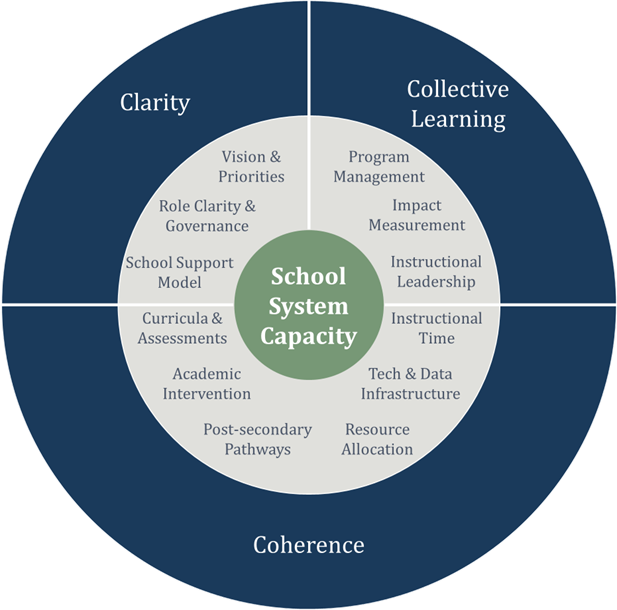
School System Capacity is built across three interdependent dimensions:
Clarity — shared priorities and defined decision rights
Coherence — fewer, better-aligned programs actively managed over time with the resources and structures needed to support them
Collective Learning — infrastructure to monitor implementation, incorporate feedback, and improve continuously
Steubenville City Schools shows what this looks like in practice: 95% third-grade reading proficiency sustained for nearly two decades in a community where 99% of students experience economic hardship. The program mattered, but the system around the program mattered more.
LearnScope's School System Capacity Model assesses twelve domains across a four-level maturity scale, giving leaders a structured starting point for identifying where to focus.
The organizational overload described in Part 1 of this series is not inevitable. Initiative Debt, the Perfect Program Myth, and the Autonomy Trap are the result of system design choices that have emphasized adding more rather than operating better. They are also alterable. District leaders can rebuild the capacity of their school systems by shifting their focus from which programs they deploy to the organizational conditions that determine whether those programs succeed.
Through work with school districts across the country, we have found that school system capacity is built across three interdependent dimensions: Clarity, Coherence, and Collective Learning. LearnScope’s School System Capacity Model assesses each of these three dimensions across twelve specific domains, giving district leaders a structured way to identify where their organization is strong, where it is stretched, and where to focus their effort.
We have also observed that districts tend to fall along a maturity spectrum in each of these areas, so each domain is scored on a four-level maturity scale.
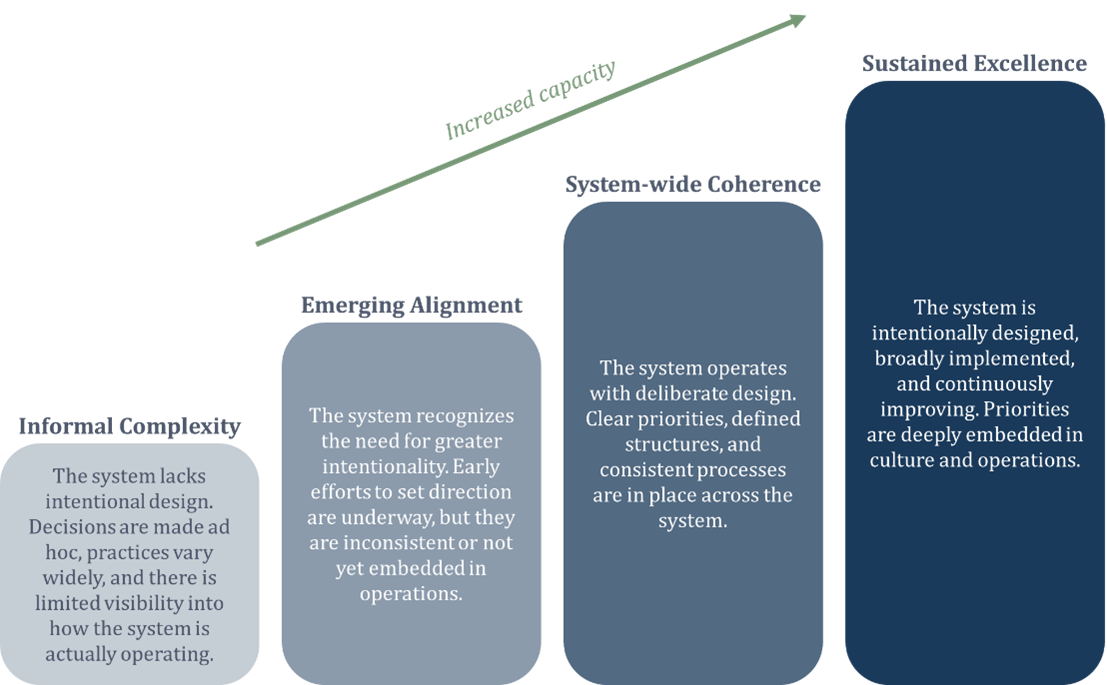
A truncated model, including indicators for seven domains, is available through LearnScope’s School System Capacity Self-Assessment. The sections that follow describe each dimension in more detail and illustrate what these ideas look like in practice.
Clarity
Clarity is the foundation for simplification, alignment, and focus. Districts with strong capacity have an unusually clear picture of what they are trying to accomplish, who is responsible for what, and how they will know if their efforts are working.
This goes beyond a strategic plan. It means establishing a small number of priorities that are understood the same way by every principal and teacher in the system, defining decision rights so educators know where they have flexibility and where they do not, and building theories of action that connect daily practice to measurable outcomes.
In districts experiencing overwhelming complexity, the first step is almost always reestablishing this shared understanding. This does not mean micromanaging. It means making the district’s expectations explicit enough that professional judgment can be exercised within a coherent framework. Clarity is the direct antidote to the Autonomy Trap described in Part 1, because it creates the guardrails that allow school-level flexibility to coexist with system-wide coherence.
Coherence
Coherence is what makes Clarity actionable. It is the degree to which a district’s programs, staffing, professional development, and resource allocation work in concert rather than in competition.
Districts with high Coherence tend to have fewer programs, but the programs they have are tightly aligned with their priorities, resourced for quality implementation, and actively managed over time. Rebuilding Coherence often requires leaders to make difficult decisions about what to stop doing: retiring legacy initiatives, consolidating technology tools, streamlining professional development, and more, so that the system’s attention is concentrated where it matters most.
This is the dimension most directly connected to Initiative Debt. A district cannot reduce its accumulated complexity without deliberately choosing which programs to keep, which to retire, and which to consolidate. Coherence is the discipline of doing that work.
Collective Learning
Collective Learning is what sustains capacity over time. Even districts with strong Clarity and Coherence will stall if they lack the infrastructure to learn and adapt as conditions change.
This means building systems for monitoring implementation quality, creating feedback loops so that insights from classrooms inform district decisions, and investing in the routines and relationships that allow educators to learn from one another.
Collective Learning, when done well, is not a program evaluation completed in a spreadsheet to determine if a program “worked.” It is a process that thoughtfully incorporates quantitative data, observational indicators, and qualitative feedback to provide a complete picture of which parts of the program are working for which students and why. Building Collective Learning systems that are aligned with day-to-day efforts helps the district improve its services over time and respond to unanticipated needs.
Collective Learning is also what breaks the cycle of the Perfect Program Myth. When a district has real infrastructure for understanding how a program is performing and why, the instinct to swap programs at the first sign of disappointing results gives way to a more productive question: What about our implementation needs to change?
These three dimensions are not theoretical. They can be observed in real districts delivering exceptional results.
Case Study: “Systems Elevate Averages” in Steubenville (OH)
Steubenville City Schools has been described as “the best school district in America” for its exemplary, sustained student outcomes.[i] For nearly two decades, the district has helped 95% of its third-grade students reach reading proficiency in an Appalachian community where 99% of its 2,800 students experience economic hardship. It was not always this way; in 1999, roughly one-quarter of students were reading below grade level.[ii]
How has Steubenville driven systemic, sustained performance? They built system capacity to support a clear priority. In the words of Steubenville’s former superintendent, “there is no question that systems elevate averages. If you get people to work together…[and] if you have a system that goes grade level to grade level it is less adjustment for the learner and you see better results.”[iii]
-
Leaders in the district defined a clear priority – to “change the path of poverty” by helping every student read proficiently by third grade – and they built buy-in among critical constituencies. Teachers voted unanimously to adopt an evidence-based, scripted literacy curriculum (Success for All) in 2000. Everyone in the schools plays an active role during the daily common literacy block to help students learn to read. As one teacher described, “We’re all on the same page.”[iv]
-
The Steubenville team stresses the importance of having a consistent, coherent system of instruction: “Before Success for All, each teacher…was in charge of his or her classroom curriculum and the quality was inconsistent. That changed dramatically with Success for All, which is highly scripted. Teachers get manuals outlining the material they should cover every day along with specially created materials…[and] each year builds on the previous year’s knowledge.”[v]
The district’s curricular focus also reduced the burden on classroom teachers while offering them greater flexibility as they built expertise within the program. The structure of the curriculum “frees [teachers] from having to spend hours developing lesson plans and allows [them] to concentrate on giving each child what he or she needs. Because all teachers in the school use the same curriculum, [they] can help each other.”[vi]
An elementary school principal described her experience starting as a new teacher in Steubenville as a “relief to have a guideline to follow…because I was more or less winging it anyways,”[vii] like so many early-career educators. On the other hand, according to a district instructional coach, the district “would encourage a new teacher to follow the scripted lesson and then after that teacher becomes more comfortable with that framework, in the second or third year, that is when they begin to tweak it to work for their students and themselves.”[viii]
By simplifying and standardizing key elements of the instructional system, the Steubenville team is able to offer higher quality, more consistent support to educators, which has translated into excellent results.
-
The system prioritizes learning with a focus on elementary literacy at all levels – classroom, school, and district. In the classroom, “a great deal of time is devoted to gathering accurate information about student performance” and the district’s instructional coaches leverage their knowledge of the curriculum and the community to provide “feedback that is specific” to individual teachers, classrooms, and school leaders.[ix]
Further, the district has established structures and culture that emphasize learning and growth rather than compliance. In a publicly available example from Steubenville, you can listen to a principal engaging in collective learning with a district coach. The theme of the interaction is summed up with the sentiment: “There are always solutions but you need to understand the data to understand the problem.” The team’s grounding in a common instructional vision enables them to engage in more constructive, evidence-driven decision-making processes.[x]
A note on what the Steubenville case is and is not. This is not a story primarily about Success for All as a program. Although it is a terrific, evidence-based program, other districts have adopted Success for All and not achieved the same results. The lesson is that Steubenville built the organizational capacity to make their chosen program work, including clear priorities that everyone understood, a coherent instructional system that reduced burden on teachers, and a learning infrastructure that helped the district improve over time. The program mattered, but the system around the program mattered more.
Getting Started
None of this is easy. Rebuilding school system capacity requires district leaders to resist the gravitational pull of “doing more” and make deliberate choices about how their organizations operate. It requires honest assessment of where current systems are falling short and the discipline to invest in organizational infrastructure that is less visible than a new technology platform but more impactful. It requires persistence; the complexity that has accumulated over decades will not be resolved in a single school year.
K-12 leaders have the opportunity to make a different choice. Steubenville did not transform their outcomes by finding a silver bullet. They did it by building a system that made every educator more effective.
LearnScope’s School System Capacity Self-Assessment is designed to help you and your leadership team identify where your system is strong and where the most productive opportunities for improvement lie. The assessment covers most domains of the capacity model and provides a structured starting point for the conversations that matter most. We would encourage you to take the assessment yourself and then invite your cabinet and principals to do the same. The differences in how people across the system perceive capacity are often as revealing as the scores themselves.
Resources
Take LearnScope’s School System Capacity Self-Assessment
Sign up for our newsletter for more free resources and insights
If you are interested in learning more about how LearnScope can help support you and your team, let’s have a conversation!
[i] Chad Aldeman, “Why Steubenville, Ohio, Might Be the Best School District in America,” The 74, April 2, 2025, https://www.the74million.org/article/why-steubenville-ohio-might-be-the-best-school-district-in-america/.
[ii] Karin Chenoweth, “ExtraOrdinary Districts: Season 1, Episode 3: Steubenville, Ohio — Part 1: Changing the Path of Poverty,” ExtraOrdinary Districts (podcast), The Education Trust, 2019, https://edtrust.org/extraordinary-districts/extraordinary-districts-episode-3-steubenville-ohio/.
[iii] Karin Chenoweth, “ExtraOrdinary Districts: Steubenville, Part 2 — A Program in Service of a Vision,” ExtraOrdinary Districts (podcast), The Education Trust, 2019, https://edtrust.org/blog/steubenville-part-2-program-service-vision-2/.
[iv] “Education Nation: ‘Success for All’ Curriculum Drives Ohio District,” The Hechinger Report, September 24, 2012, https://hechingerreport.org/education-nation-success-for-all-curriculum-drives-ohio-district/.
[v] Karin Chenoweth, “ExtraOrdinary Districts: Steubenville, Part 2 — A Program in Service of a Vision,” ExtraOrdinary Districts (podcast), The Education Trust, 2019, https://edtrust.org/blog/steubenville-part-2-program-service-vision-2/.
[vi] Karin Chenoweth, “ExtraOrdinary Districts: Season 1, Episode 3: Steubenville, Ohio — Part 1: Changing the Path of Poverty,” ExtraOrdinary Districts (podcast), The Education Trust, 2019, https://edtrust.org/extraordinary-districts/extraordinary-districts-episode-3-steubenville-ohio/.
[vii] Karin Chenoweth, “ExtraOrdinary Districts: Season 1, Episode 3: Steubenville, Ohio — Part 1: Changing the Path of Poverty,” ExtraOrdinary Districts (podcast), The Education Trust, 2019, https://edtrust.org/extraordinary-districts/extraordinary-districts-episode-3-steubenville-ohio/.
[viii] Karin Chenoweth, “ExtraOrdinary Districts: Season 1, Episode 3: Steubenville, Ohio — Part 1: Changing the Path of Poverty,” ExtraOrdinary Districts (podcast), The Education Trust, 2019, https://edtrust.org/extraordinary-districts/extraordinary-districts-episode-3-steubenville-ohio/.
[ix] Karin Chenoweth, “ExtraOrdinary Districts: Season 1, Episode 3: Steubenville, Ohio — Part 1: Changing the Path of Poverty,” ExtraOrdinary Districts (podcast), The Education Trust, 2019, https://edtrust.org/extraordinary-districts/extraordinary-districts-episode-3-steubenville-ohio/.
[x] Karin Chenoweth, “ExtraOrdinary Districts: Season 1, Episode 3: Steubenville, Ohio — Part 1: Changing the Path of Poverty,” ExtraOrdinary Districts (podcast), The Education Trust, 2019, https://edtrust.org/extraordinary-districts/extraordinary-districts-episode-3-steubenville-ohio/.
-
School system capacity is the organizational infrastructure that determines whether a district can reliably translate its investments in programs, people, and practices into outcomes for students and educators. It is built across three interdependent dimensions: Clarity (shared understanding of priorities, roles, and success measures), Coherence (programs, staffing, and resources working in concert rather than in competition), and Collective Learning (feedback loops, implementation monitoring, and professional learning systems that help the district improve over time). LearnScope's School System Capacity Model assesses these dimensions across twelve specific domains.
-
LearnScope's School System Capacity Model is a diagnostic framework that assesses district organizational capacity across three dimensions and twelve domains. Each domain is scored on a four-level maturity scale, giving leaders a structured way to identify where their system is strong, where it is stretched, and where to focus their effort. A truncated version of the model is available through LearnScope's free School System Capacity Self-Assessment tool.
-
Clarity is the foundation for simplification, alignment, and focus. It means establishing a small number of priorities that are understood the same way by every principal and teacher in the system, defining decision rights so educators know where they have flexibility and where they do not, and building theories of action that connect daily practice to measurable outcomes. Clarity is the direct antidote to the Autonomy Trap because it creates the guardrails that allow school-level flexibility to coexist with system-wide coherence.
-
Coherence is the discipline of making clarity actionable. Districts with high coherence tend to have fewer programs, but those programs are tightly aligned with priorities, resourced for quality implementation, and actively managed over time. Rebuilding coherence typically requires difficult decisions about what to stop doing: retiring legacy initiatives, consolidating technology tools, and streamlining professional development so that the system's attention is concentrated where it matters most. Coherence is the dimension most directly connected to reducing Initiative Debt.
-
Collective Learning is the infrastructure that sustains capacity over time. It includes systems for monitoring implementation quality, feedback loops that connect classroom-level insights to district-level decisions, and routines that help educators learn from one another. Effective collective learning goes beyond program evaluation in a spreadsheet; it incorporates quantitative data, observational indicators, and qualitative feedback to understand which parts of a program are working, for whom, and why. Collective Learning is what breaks the cycle of the Perfect Program Myth by replacing the instinct to swap programs with a more productive question: what about our implementation needs to change?