
Why focus on evidence-based management in K-12 education?
Bringing the same level of rigor to management decisions as we do to instructional practice
-
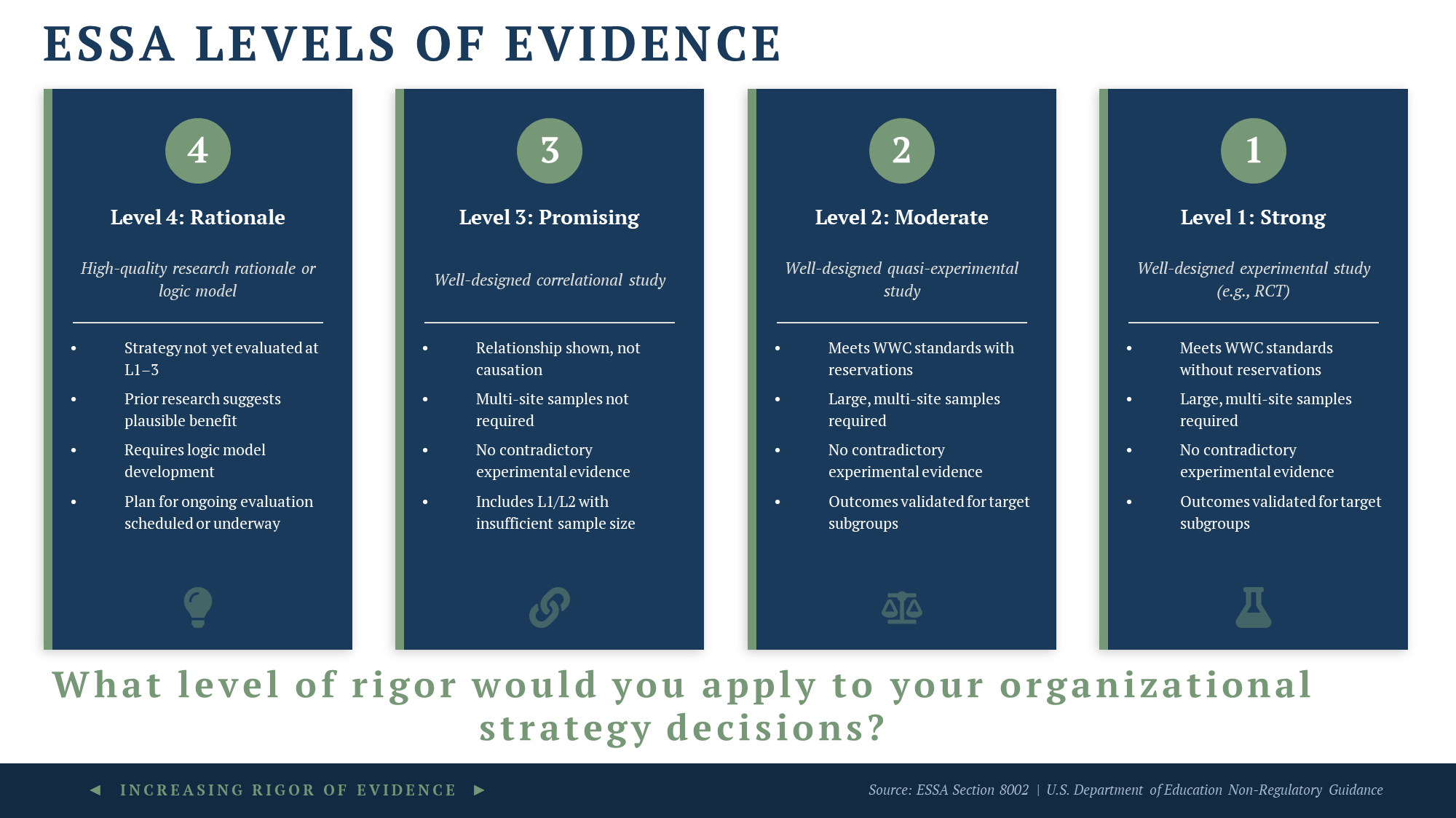
The ESSA Evidence Framework transformed how educators evaluate instructional programs. No comparable standard exists for school system design, strategy, or operations.
In many districts, the evidence behind high-stakes organizational decisions would fall below even the lowest ESSA benchmark.
District leaders facing deepening student needs, policy uncertainty, and AI disruption need the same rigor for management decisions as we expect for instruction.
LearnScope's School System Capacity Model gives leaders a structured, research-derived way to assess their organization's capabilities and define where to focus.
Evidence-Based Practices for Instruction
Educators love evidence. Data-driven instruction. Formative assessments. Instructional rounds. Specific, actionable feedback. It is no wonder that the Every Student Succeeds Act (ESSA) Framework for Evidence-Based Interventions has become a nearly universal standard for program selection decisions across the country.
The ESSA Evidence Framework (and its predecessor, the What Works Clearinghouse) established a common definition and language for educators, leaders, vendors, and policymakers to discuss the demonstrated quality of instructional programs. The common framework helped catalyze an expansion of the evidence base and scale of adoption of evidence-based curricula and instructional practices. Today, if you are a leader evaluating new curricula, technology tools, or tutoring programs, you can likely find some credible research to inform your choice.
But where do leaders go to find evidence on school system design, strategy, and operations?
Evidence-Based Practices for Management
Research on the organizational strategy topics most crucial to school system success remains extremely limited. Evidence-based programs under ESSA cannot improve support for educators or students without proper organizational infrastructure. We have seen this pattern play out in countless districts across the country. Yet, K-12 leaders often lack access to proven strategies – or even a clear view into potential options – for these key decisions.
Consider the quality of evidence your district used to make a recent decision about organizational strategy. Where would it fall on the ESSA evidence framework? In my experience, the evidence supporting these high-stakes decisions regularly falls below even the lowest ESSA benchmark, in large part because it is difficult to find supporting research.
District leaders are facing an unprecedented confluence of challenges today, including deepening student needs, increased policy uncertainty, and emerging disruption from artificial intelligence. They need proven strategies for designing, organizing, and sustaining high-quality support for educators and students more than ever before.
LearnScope is on a mission to equip leaders with the same standard of evidence to support their management decisions as we have come to expect for instruction.
Our Theory of Action
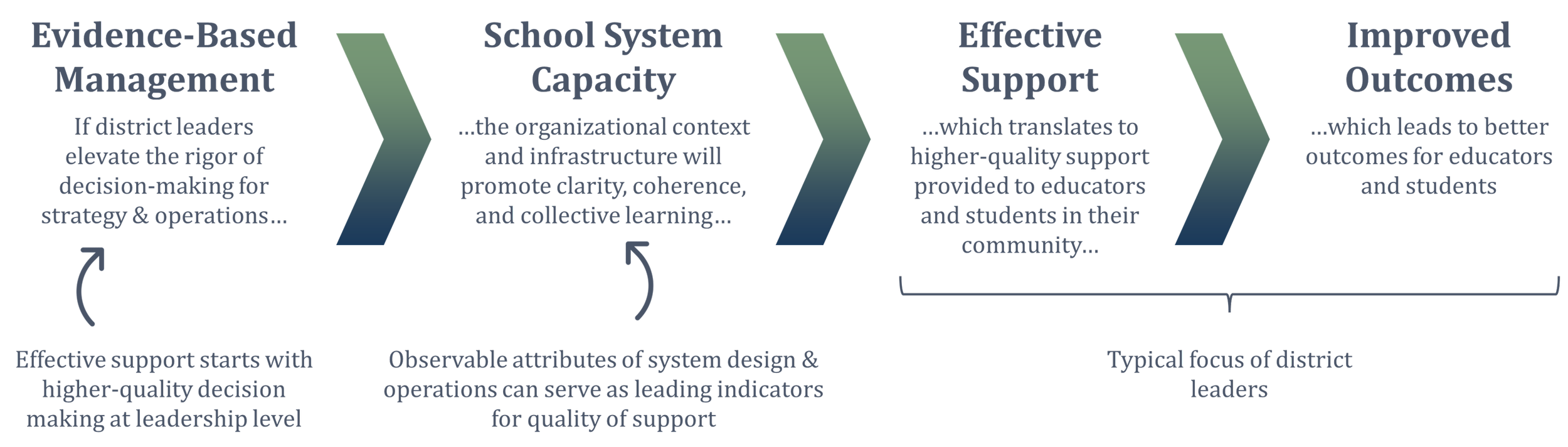
We believe that K-12 district leads have a unique opportunity to improve the quality of support provided to educators and students in their community, and it starts with increasing the rigor of management decisions.
Getting Started
We are in the early stages of the movement toward evidence-based management for K-12 districts, similar to where the curriculum landscape was two decades ago before the investment in high-quality instructional materials – lots of homegrown approaches, limited visibility into usage, and minimal third-party research.
In this context, a realistic starting point is reaching at least the ESSA Level 4 threshold for evidence. That means defining a clear logic model for organizational strategy, grounded in student performance data, educator feedback, and community input.
Our first initiative, the School System Capacity Model, supports leaders on this journey. The Model was derived from interdisciplinary research and adapted to the K-12 context to help district leaders assess their own organization’s capabilities, define specific priorities, and build greater capacity to deliver outcomes for their communities.
In the long term, the intent is to build upon this framework to guide research and practice around district strategy and operations, enabling more rigorous, evidence-based decisions.
If you are interested in learning more:
Subscribe to our newsletter below for twice-monthly insights and tools
Take LearnScope’s School System Capacity Self-Assessment to understand the strengths and opportunities within your own organization
Reach out to start a conversation about how LearnScope can support you and your community