
The “hidden” organization in K–12 school systems
Early in my career as a technical assistance provider, one of my clients was an exceptional leader brought in by the state education agency to lead a turnaround of a chronically underperforming school system.
She did not waste any time. During the first year, we worked tirelessly to restructure and refocus the district on elevating the quality of instruction. Together, we designed a turnaround strategy identified as an exemplar by the state education agency, built new norms and processes for instructional observations, and redesigned how students were identified for additional supports.
I was energized by all the progress we were seemingly making. Yet after all that work, and even though district leaders were in schools every day, we did not see evidence of meaningful changes in practice at the school and classroom level by the end of the first year.
Where did our efforts break down?
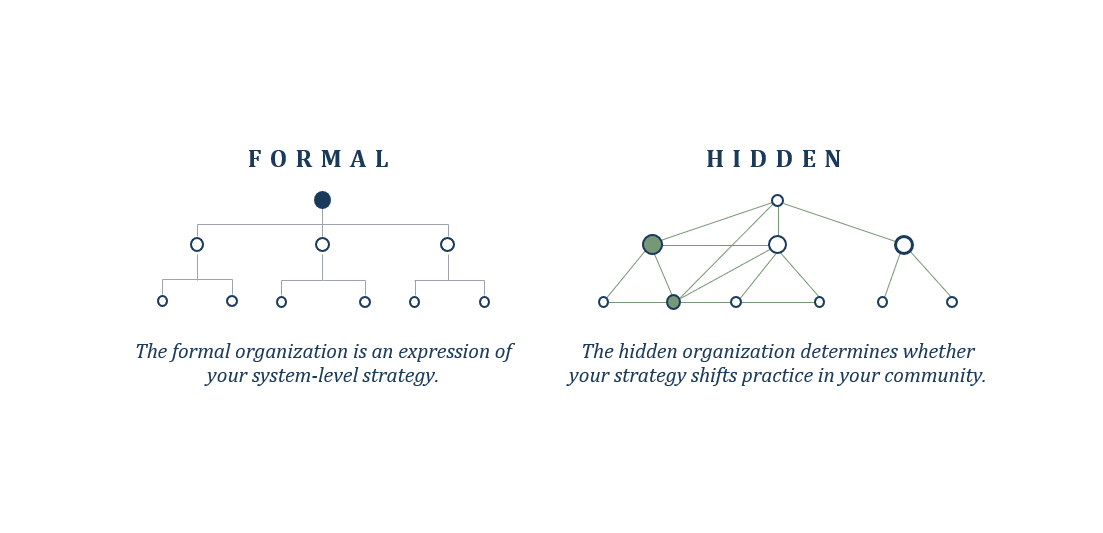
We ran into an age-old challenge in K–12 education. Formal authority only has so much influence. Education is a fundamentally human endeavor, and school systems do not operate within clean reporting lines. They run on a network of informal relationships built on expertise, trust, and collaboration. We were fighting against these relational networks, and they were completely hidden from us. No matter how hard we tried, forcing a new set of expectations and programs down through the formal organizational chart was not going to result in better outcomes for students.
Rewiring the organizational network to deepen changes in practice
In the second year, the superintendent and her deputy deployed a multi-layered strategy to shift instructional practice. We revamped the school improvement planning process, built robust collaboration structures for school leaders, and established a cross-functional strategic planning team with representation from school and district leaders. By Thanksgiving break, we started seeing a new culture and approach take root in classrooms across the city.
Each day, district leaders conducted school visits and classroom observations, just as they had in the first year. But this time they were equipped with a school improvement plan designed in partnership with the school leader, so they knew what to look for, how to contextualize their feedback, and how to inquire about barriers to success. Just as important, there was greater trust between district and school leaders because they had multiple collaboration channels and repeated interactions. Stronger trust and more intentional collaboration enabled greater alignment, faster improvement, and better support for kids.
A core reason these efforts made the changes "sticky" was that they rewired the connective tissue between key people in the district. They altered the structure of the organizational network, strengthening ties and building bridges in critical areas, which made the whole organization more resilient and adaptable.
This is, in many ways, what leading student-centered change during challenging times looks like. The district leadership led with a thoughtful, responsive strategy that increased the capacity of their district.
Yet I cannot help but think about how hard we had to work to get there. What could we have done to improve instruction sooner rather than waiting and hoping next year would be better?
If we had visibility into the full picture of the organizational network, could we have deployed more targeted, influential change management efforts? If we focused on the importance of the organizational network, what else could we have done to promote the flow of information and support across the community?
Why the "hidden" organization matters for K–12 system leaders
After working with hundreds of K–12 leaders across the country, directly and through teams I have led, I have come to appreciate how powerful the "hidden" organization is in delivering outcomes for students and educators. Decades of research, including from Daly, Finnigan, Coburn, and others, has shown that informal networks shape whether reforms reach classrooms and sustain over time. In most cases, leaders are operating on intuition without visibility into the true network of relationships that shapes how information, expertise, and trust move through the organization.
Organizational network analysis makes that informal, hidden organization visible. It reveals where connections between the central office and schools are strong and where they could be improved. It surfaces who your most influential leaders are regardless of whether they have the formal title to match. It shows how expertise flows through the organization and where it gets stuck, never reaching the educators who need it.
Leveraging methods built on decades of interdisciplinary research, including within K–12 education, LearnScope can build an organizational network map to help you take a more targeted, strategic approach to building School System Capacity.
We help leaders see their organization more clearly, make more informed decisions, and establish ways of working that amplify their impact in their communities.
If you want to learn more about how to analyze your hidden organization, download our network analysis overview or set up a 1:1 conversation with us here.
-
What is organizational network analysis (ONA) in K–12 education?
Organizational network analysis (ONA) is a research-based method for mapping the informal relationships through which information, expertise, and trust flow inside a school district. It surfaces who collaborates with whom, where bridges exist between schools and the central office, and where critical knowledge is concentrated or stuck.
How is organizational network analysis different from an org chart?
An org chart shows formal reporting lines and titles. An organizational network map shows the informal relationships that actually drive practice: who leaders turn to for advice, which principals influence their peers, and where expertise crosses or fails to cross departmental lines. The two are complementary, but in school systems the informal network is often a stronger predictor of whether change takes hold.
Why does the informal organization matter for K–12 system leaders?
School systems operate on relationships, not just policy. The strength of informal networks influences how quickly new practices spread, whether reforms reach classrooms, and whether trust is sufficient to sustain change. Leaders who cannot see these networks are managing only part of their organization.
How can a superintendent use organizational network analysis?
Superintendents use ONA to identify trusted bridges between the central office and schools, uncover the most influential educators in their system, diagnose where information and expertise get stuck, and design strategies, structures, and collaboration routines that strengthen the connections that matter most for School System Capacity.
What does an organizational network analysis engagement look like in a school district?
A typical engagement includes a survey of district and school staff, network mapping of the resulting data, and findings sessions with leadership. The output is a clear picture of how the district actually works, paired with strategic recommendations for where to invest in stronger ties, better bridges, and more deliberate ways of working.